our garden journal

our garden journal

Saturday, July 31, 2010


Serendipity?

There are many lessons in the garden; one is not to leave the wheelbarrow sitting where it can collect rainwater, you will only harvest mosquitoes! So as I was thinking “I need to bring my wheelbarrow up here” I rounded the storage shed and saw a wheel barrow! “I’ll use that” I thought, then realized it was full of water which made me full of anxiety! Sure I would find mosquito larvae wiggling about I peered in, wondering if I had the strength after a long day of gardening to dump out all that water. “But those are tadpoles!” It looked like 3 different stages of development were represented so more than one frog found our little metal wetland. Now instead of dumping it out I wonder every day “does the wheelbarrow need more water?”

Is this a chance to increase our vocabulary? Serendipity? Flabbergasted? Luck? Or learn about the web of interdependence, isn’t it great the tadpoles eat mosquito larvae? What is a larva (what are larvae) anyway? Sharpen powers of observation drawing the tadpoles? Write a poem? Research beneficials in the garden and decide if we want frogs? Have a philosophical debate about protecting the frogs versus letting nature take its course and if it rains they live if the wheelbarrow dries out they die, versus dumping the whole thing and using the wheelbarrow just because I need a wheel barrow! (eminent domain?)

Or simply take a breath smile and know biophilia is the real reason you garden even if you have never seen the word or heard of E.O. Wilson.

Maybe I’ll dig a little pond some day!

Most children have a bug period, and I never grew out of mine.
Edward O. Wilson, Naturalist

Humanity is exalted not because we are so far above other living creatures, but because knowing them well elevates the very concept of life.
Edward O. Wilson, Biophilia, 1984, p. 22

I have argued in this book that we are human in good part because of the particular way we affiliate with other organisms. They are the matrix in which the human mind originated and is permanently rooted, and they offer the challenge and freedom innately sought. To the extent that each person can feel like a naturalist, the old excitement of the untrammeled world will be regained. I offer this as a formula of reenchantment to invigorate poetry and myth: mysterious and little known organisms live within walking distance of where you sit. Splendor awaits in minute proportions.
Edward O. Wilson, Biophilia, 1984, p. 139

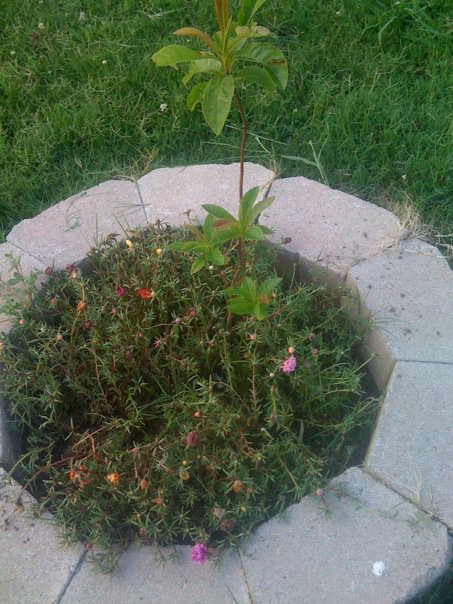
Monday, July 26, 2010

Every year I am determined to start a fall garden, it's just so easy to let all of springs efforts burn to a crisp while sitting under the air conditioner but then as fall cools off and you survey what could have been a great crop of fall veges regret sets in! So get out there in the "cool" of early morning and evening or work in short spurts if you must work in the heat and keep those tomatoes watered and picked and start your fall crops! You should have some sort of watering system that just requires you to turn on the faucet and your drip hoses will do the rest. August will require water and you won't want to stay out in the heat too long so make basic tasks like watering easy with drip hoses and mulch. Newspaper, straw, grass clippings and mulch from the green waste site on 56th street north (east of Mingo west of highway 169) all help keep the soil cool and moist. As fall sets in we will want your bags of leaves for Cherokees vegetable garden. We might also compost right in the beds to some degree, we do need more organic matter to help our soil retain moisture better and increase fertility.

I have cleaned out one bed at Cherokee and planted squash and beans while using the lettuce which had gone to seed as part of the mulch. I would love to have some volunteers to help keep the tomatoes going so the students can come back to school and find a beautiful crop of yellow pear tomatoes, the plants will stop producing if we don't keep them picked and watered. Obviously your reward for weeding and watering can be handful of tomatoes!

OSU extension is a great source of gardening information, they should be on your favorites list!
http://pods.dasnr.okstate.edu/docushare/dsweb/Get/Document-1114/HLA-6009web.pdf

Sunday, July 11, 2010

Inventory, July 11, 2010

Just took a quick tour of the grounds at Cherokee to help focus our efforts in this hot time of year, hoping to have something to show for our efforts when school is back in session.

vegetables
The volunteer who was going to lead the vegetable garden efforts has not been able to be as active as she hoped so we would welcome help in the vegetable garden. Produce can be donated to the food pantry or handed out when we are giving out free lunches this summer or eaten by the volunteers and their families. We had some corn kohlrabi and tomatos to feed some of our volunteers at lunch today at A Third Place Community Center. We would love to see several Cherokee School families eating out of this garden. Fall planting is a great idea in Oklahoma, we can extend our gardening season. Right now the grass needs mowing and we need to mulch around the fence to keep grass from creeping under and perhaps use the lasagna gardening technique to smother grass and weeds inside the fence. This can be done by covering the ground with a thick layer of newspaper (10-12 sheets or so) then topping that with soil for planting or mulch for paths. I saw 4 squash or similar plants (planted by students before school was out) that are growing into what is taller and taller grass, we need to mulch this area so the squash wont accidentally be mowed.

front beds
the front beds are looking great, recently weeded and mulched but the grass is tall and setting seed which I am afraid will blow into the beds when the area is mowed. Considering the budget crunch it would be great if a volunteer could at least mow a perimeter around the beds in front. We are also looking for a volunteer per bed so we each have a specified area to call our own.

south garden, the bird banquet
the trees planted near the bird feeder south of the school will be a pain to mow around, if we could mow this area very short then mulch and keep filling in with shrubs and trees till its shady enough to have fewer weeds that would be great, we also need benches to help with birdwatching classes.

numbers
while taking the tour i finally got around to counting. We have planted around 38 trees and 52 shrubs. Dont make me count the daffodils perennials seeds vegetables groundcovers....as soon as it is cool enough we will resume filling in the flower beds and planting groundcovers under the shrubs, my goal is thick enough plantings to disccourage weeds.

An Introduction to Lasagna Gardening

Saturday, July 10, 2010

J C Raulston and the Leyland cypress

I chose a Leyland cypress to screen a downspout from view not just because it was on sale but so we can talk about J C Raulston when we are in the garden and teach students words like ubiquitous and irony and the importance of diversity. How ironic that one of his introductions became ubiquitous! This tall narrow tree (Cuprocyparis leylandii) has been used commonly as a screen mainly due to its introduction as a screen at the arboretum Raulston established on the campus at North Carolina state university in 1976. Later the arboretum would be renamed the J. C. Raulston Arboretum. He realized we used the same plants over and over again and many fascinating plants were not available at nurseries. At the North Carolina State University Arboretum that this Oklahoma native (OSU graduate) was directing he was able to introduce many new plants to the nursery trade and therefore to gardeners. He allowed nursery owners to take cuttings from any of the arboretums plants and encouraged propagation of many plants that were not available to the home gardener. The irony is that the Leyland cypress was quickly overused and due to that was often destroyed by diseases that found it easy to move from tree to tree. But Dr. Raulston who kept introducing new plants until he died in a car accident at age 56 had other plants to suggest by the time the Leyland cypress became so common that disease could spread easily through the community. His generosity energy and passion for diversity are why we can have so many different plants available at local nurseries today.


JC Raulston Arboretum - J. C. Raulston

Thursday, July 8, 2010

Tulip poplar

The evening before our planting extravaganza last fall I was loading up plants to move to Cherokee for planting the next morning when suddenly I was heartbroken, the beautiful little tulip tree I was so proud to donate and eager to watch grow was nearly leafless, one last leaf clinging to the top. “ Oh well it will be ok” I thought, loaded it up and expected recovery by spring but gave up on a little fall color (reportedly yellow!) How silly I felt the next day when Katie brought me the pot our tulip tree (Liriodendron tulipifera) had been in and said “Aunt Bonnie what is that?” I had to laugh at myself, I wanted the tulip tree to teach the students about the host plants for butterflies specifically the Tiger Swallowtail (Papilio glaucas), Oklahoma’s state butterfly. There on the side of the flower pot was the source of carnage, a swallowtail pupa! We want butterflies without losing leaves? My dream had come true and I almost missed it!

http://www.butterflygardening.org/tips/growhost.html

Wednesday, July 7, 2010

American wisteria

A friend gave me what appears to be an American wisteria so of course I planted it at Cherokee on faith that an arbor sturdy enough for this vine would appear before the vine overruns the bed! My hope is that a bench/arbor at the back of the bed can not only host this vine but give the students a place to sit and observe butterflies in the butterfly host plants in front of the bed or consider color theory in this mix of perennials. They can also observe the differences between Chinese and American wisteria and consider why we have so many plants so similar to plants from China. They may even study the Arnold Arboretum in Jamaica Plain Massachusetts for its mission to collect plants from China that will grow in Massachusetts. But I still need that arbor, anyone up for carpentry?
Arnold Arboretum - Boston China Summer

Monday, July 5, 2010


The lessons (and mysteries) of the Franklinia


Every plant in the Cherokee garden has many lessons to teach but the Franklinia tree is one of the most thought provoking. I planted it as much for its place in Americas plant history as for it's beauty. Why is this tree extinct in the wild? What does it mean that thanks to John Bartram we still have it? This link says it best.


America's 'First' Rare Plant: The Franklin Tree, by Lucy M. Rowland : Articles : Terrain.org
www.terrain.org